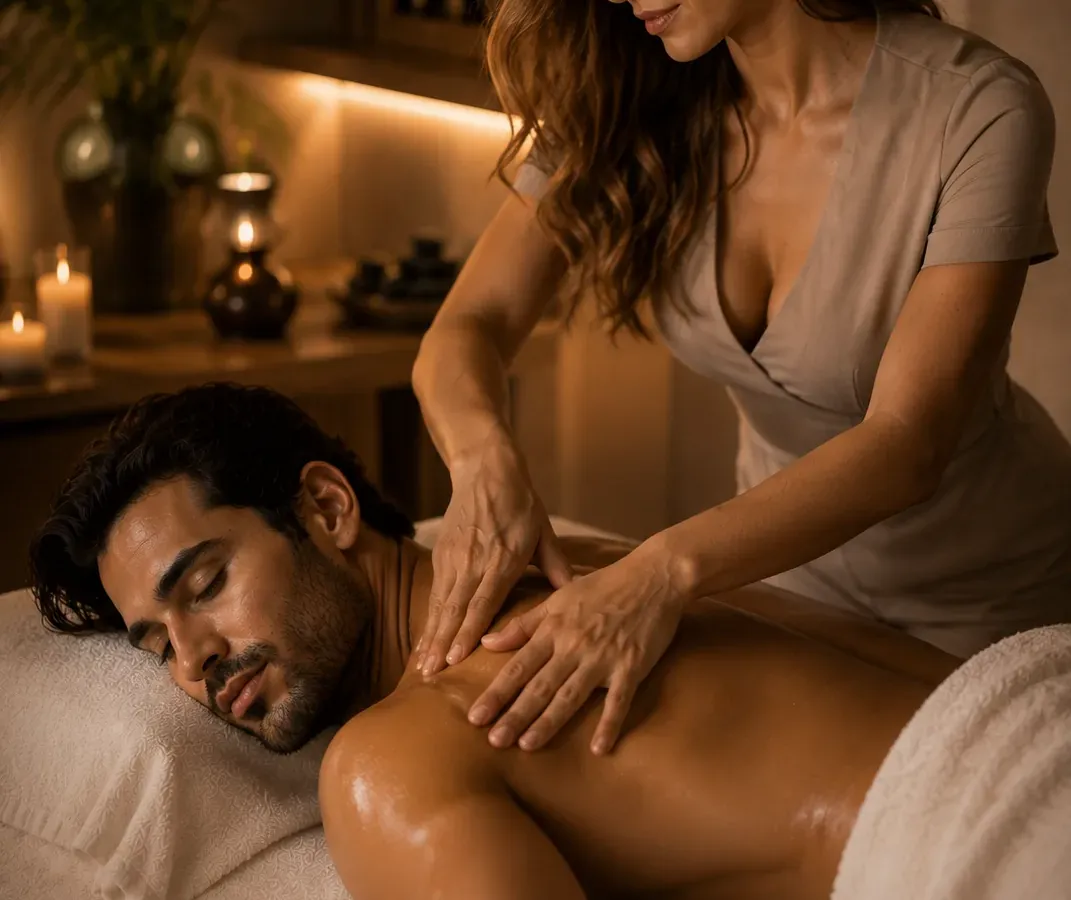
Nuru is the most physical of the techniques we usually explain, and also the easiest to describe: instead of hands pressing on specific points, there are surfaces gliding continuously across the body. That’s the whole principle.
What’s interesting is what that change does to perception.
Where it comes from
Nuru became popular in Japan from the 1970s onward, in the city of Kawasaki, within a bathing and massage tradition centuries old. Nuru (ぬる) literally means “slippery”, and the name describes the technique rather than any spiritual concept.
Unlike yoni or lingam, which come out of Indian tantra, nuru does not come from a religious worldview. It is a bodily technique. That it is practised today within tantric rituals is a later integration, and it’s honest to say so: it was absorbed because the sensory effect fits what a ritual is after, not because it shares a historical root.
The gel: what it is and why it matters
The distinguishing element is the gel, made from nori seaweed (Porphyra) — the same family of algae used in Japanese cooking. Its properties explain the entire technique:
- It is extraordinarily slippery and stays that way far longer than conventional oil, which absorbs.
- It is odourless and colourless in its refined form, so it doesn’t compete with the room’s aromatherapy.
- It retains heat, which sustains a steady sense of temperature through the session.
- It rinses off with warm water. No greasy film on the skin, no residue in the hair.
In professional practice the gel is warmed before application. Cold gel cuts the experience off at the root: the body contracts and never quite lets go again.
How the room is prepared
Nuru has a logistical requirement other techniques don’t, which is why not every space offers it well:
- The room is warmed above the usual temperature. The body is covered in gel, and evaporation cools it.
- The work happens on a prepared waterproof surface, not a conventional massage table.
- A hot shower is available before and after, without exception.
- Hygiene protocol is stricter, precisely because more surface area and more material are involved. It’s a legitimate question to ask before booking anywhere.
How it feels
Three things, in this order:
Continuity. In a conventional massage, perception organises itself around points: pressure here, release there. In nuru there are no points. There is an unbroken path, and the brain stops anticipating the next movement. That loss of anticipation is what produces the mental disconnection most people describe at the end.
Uniform warmth. Sustained heat across the whole surface of the skin at once is an uncommon sensation. People tend to describe it as being submerged rather than as being massaged.
Weight and containment. Broad, constant contact triggers the same response as a weighted blanket: the nervous system reads containment and lowers its alert level. It’s why many people fall asleep.
What it does not produce is targeted muscular relief. If you arrive with a specific knot, nuru is not the right technique; deep pressure work resolves that better.
Nuru doesn’t undo a knot. It undoes the vigilance.
How it appears in our catalogue
This is one of the techniques we do publish by name. The price list includes the terapia nuru variants — reflejo, fruto prohibido and tentación — in 60- and 90-minute formats, with the full price in plain sight.
As with all our rituals, the professional frame is the same: there is a prior conversation, boundaries are agreed, and the session includes no contact beyond therapeutic massage. Nuru is an enveloping technique; that doesn’t change the code we work under, and we say so before you book.
Before booking
- Shower beforehand. It’s part of the protocol and it improves the session.
- Tell us about allergies. The gel is a seaweed derivative. If you’re allergic to marine products or iodine, say so in the initial conversation: it’s a real reason to choose another technique.
- Mention injuries or skin conditions. Open wounds, active dermatitis or ongoing dermatological treatment change the recommendation.
- Don’t be in a rush afterwards. You’ll want the shower and a few minutes of integration. Half an hour extra, minimum.
- Start with 60 minutes if you haven’t tried it. That’s long enough to know whether the sensation is for you.
The first conversation by WhatsApp or phone is free, and it’s the right place to settle all of this before scheduling.
Keep reading
If you’re curious about the tantric background nuru doesn’t have, the guides on yoni massage and lingam massage explain the classical pillars of the tradition. For breathwork and energy, there’s kundalini massage. And if you’re considering it for two, here’s why a couples ritual rearranges the bond.
This article is informational wellness content. It does not replace medical or psychological advice and promises no clinical outcome. If you have a health condition, talk to your own practitioner before booking.