There’s a scene that repeats itself in the conversation before a session. A couple arrives, sits down, and when we ask what brought them, neither answers straight away. They look at each other. And almost always, whoever speaks first says some version of the same sentence: “it’s been a long time since we had a moment for ourselves.”
They don’t say “we want to learn tantra.” They say they ran out of shared time.
That is the real starting point of a couples ritual, and it’s worth naming before we talk about technique, oils or breathing. What changes a bond isn’t a secret manoeuvre: it’s two hours where nobody can interrupt you, the phone stays outside, and the only plan is paying attention to each other.
Tantra doesn’t begin with the body. It begins with the agreement
In the tantric tradition, touch is never first. Intention is: why we are here, how far we go, what makes us feel safe.
Translated into an actual session, that means nobody lies down before there has been a conversation. In it, both the obvious and the rarely-spoken get defined:
- Which areas of the body are included and which are not.
- What pace works for each person — rarely the same one.
- What word each of them uses to ask for a pause.
- What they hope to feel on the way out, beyond the physical.
For many couples that conversation is, literally, the first time they’ve said those agreements out loud in front of a neutral third party. And something has already happened: intimacy stopped being a territory negotiated in half-sentences and became something that can be named without conflict.
When two people manage to say out loud what they want and what they don’t, the body relaxes before anyone has touched it.
Four things a shared ritual rearranges
1. It gives back long time
Life as a couple fills up with short encounters: fifteen minutes before sleep, a conversation while one of you cooks. A 60- or 90-minute session breaks that format. There’s nothing to solve, nobody to answer. The nervous system takes a while to believe it — the first ten minutes are almost always adjustment — and then it genuinely drops.
2. It separates touch from performance
A good share of the tension in a long relationship’s intimacy comes from every touch starting to read as a proposal, loaded with expectation and the possibility of disappointment. A guided ritual disarms that, because the frame is set in advance and there’s no goal to reach. Touch goes back to being touch.
3. It brings words back in
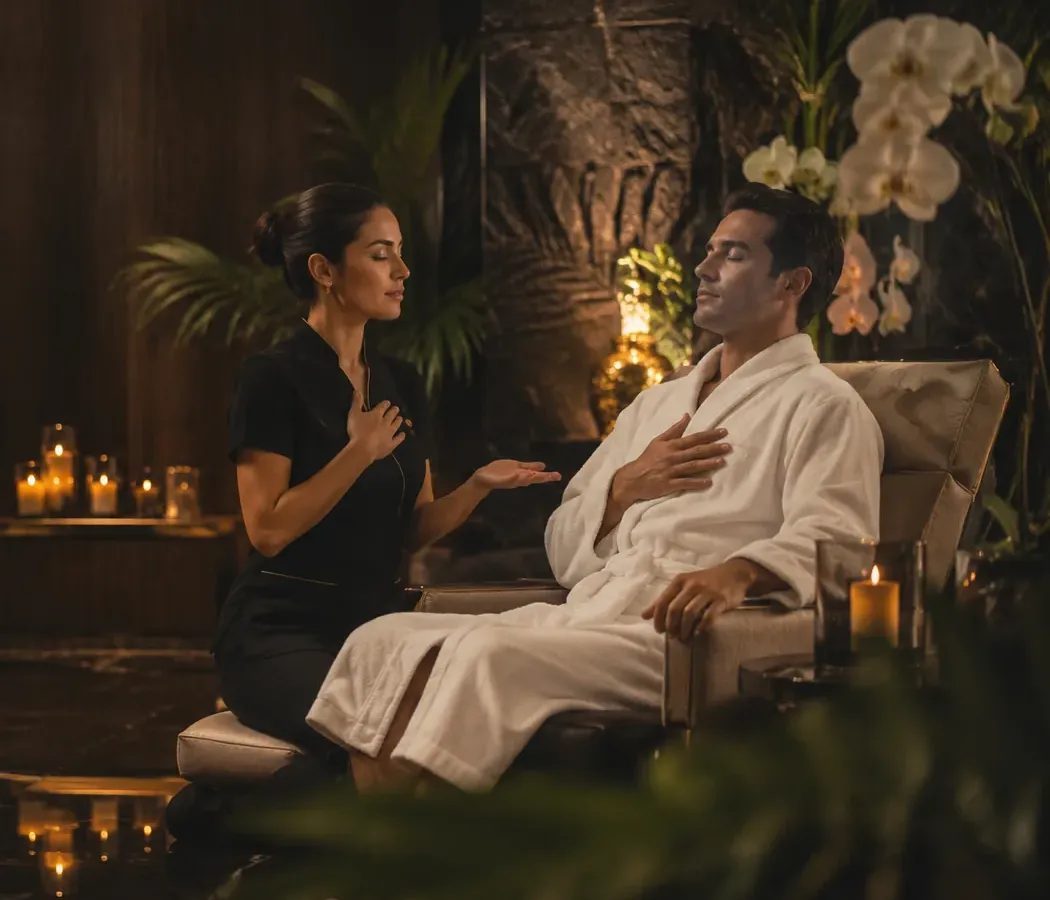
In tantra, breath and voice matter as much as hands. Breathing in rhythm with another person for several minutes is a simple exercise and a surprisingly difficult one, and it’s also the fastest way to synchronise two different moods. Many couples take that exercise home; it’s what they report back to us most often.
4. It evens out the turn
In nearly every couple there’s a quiet asymmetry: one tends to give, one tends to receive. A structured ritual assigns the turn explicitly. Receiving without having to give anything back in that moment is uncomfortable at first for whoever is used to giving — and it’s usually the part that serves them most.
What a couples session looks like at Jardín del Edén
The path is the same one we describe in the seven steps of the ritual, except the suite is prepared for two.
- Prior conversation. Private, unhurried, with the specialist who will guide you. Everything above gets defined here.
- Preparing the space. Aromatherapy, temperature, music and light, chosen according to what you said in the conversation.
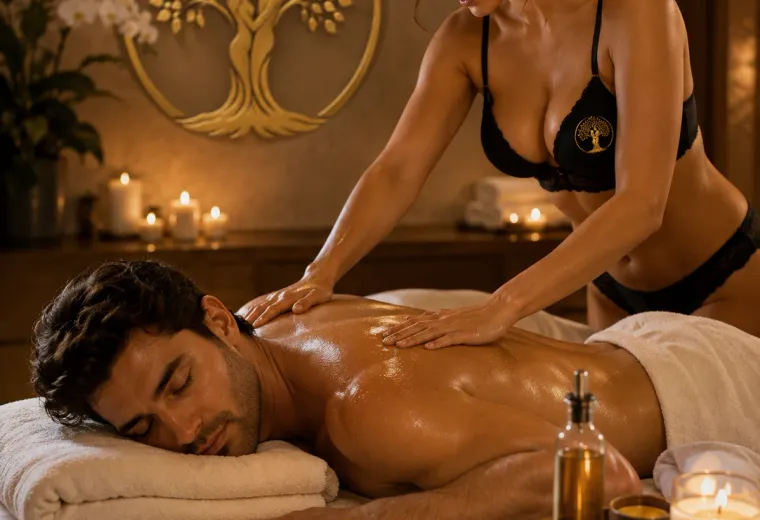
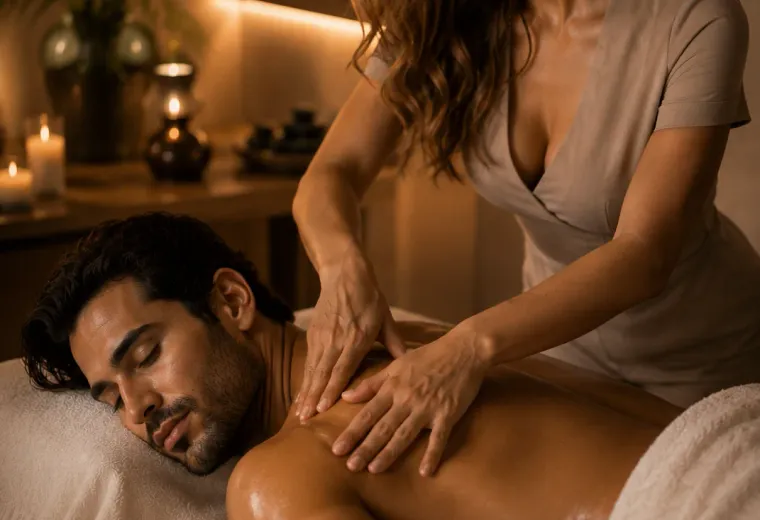
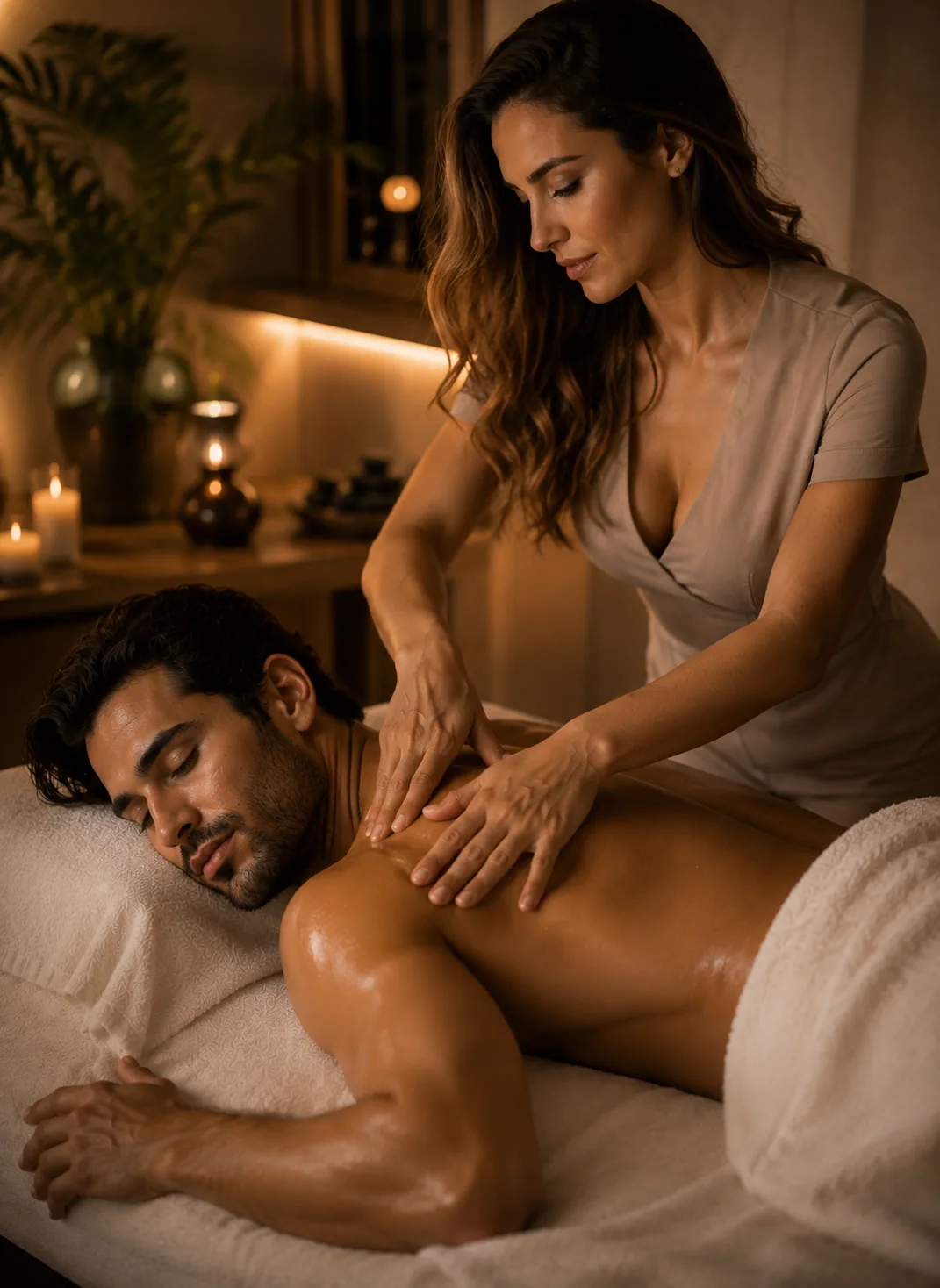
- Guided ritual. Shared breathing, conscious touch and enveloping manoeuvres, with clear instructions at every stage.
- Integration. Herbal tea, silence if you want it, and time to return to the world without rushing out.
The couples format appears in our price list as terapia rosa, in 60- and 90-minute versions. Prices are published in full: nothing appears at the end.
What a couples ritual is not
Worth being explicit, because the word “tantric” carries a lot of noise:
- It is not couples therapy. It does not replace a mental health professional. If there’s an open crisis, that consultation comes first; a ritual can accompany a process, not substitute it.
- It does not include contact beyond therapeutic massage. Our code is explicit and not negotiable. The session is professional from beginning to end.
- It is not a class. You take things home — the breathing, above all — but the point of the session is to live it, not to take notes.
- It promises no outcome. Nobody walks out of a suite with a repaired relationship. You walk out with a shared experience, which is a different material and considerably more useful.
How to prepare, concretely
- Come with nothing after. Rushing off contaminates the last half hour. If you can, keep the evening free.
- Eat light. Heavy digestion competes with relaxation.
- Talk at home first, but don’t close the subject. It’s enough that each of you arrives knowing what you’d like to feel. The details get resolved in the prior conversation.
- Agree on who books and how we reach you. We write in neutral language and coordinate through a single channel. Discretion is part of the service, not an add-on.
- Arrive ten minutes early. Not for paperwork: to breathe before starting.
If it’s your first time
Start with 60 minutes. It’s long enough for the body to understand what this is, and short enough that nobody feels committed to something they don’t know yet. If the experience makes sense to you, 90 minutes allows a slower development of each stage.
And if you’re coming with specific concerns — an injury, a pregnancy, medical treatment, a difficult history with physical contact — say so in the initial conversation, which is free and happens by phone or WhatsApp before booking. We would rather adjust the ritual, or recommend waiting, than hold a session that isn’t right.
Keep reading
To understand the techniques that may appear in a shared ritual, these three articles are the natural companion: the nuru massage, the most enveloping technique in our catalogue; the kundalini massage, centred on breath and the movement of energy; and the two guides on the classical pillars of the tradition, yoni massage and lingam massage.
If you’d rather sort it out by talking, the first conversation is free.
This article is informational wellness content. It does not replace medical or psychological advice and promises no clinical outcome. If you have a health condition, talk to your own practitioner before booking.